Piste Overview
Blue
60.2 km (54%)
Red
33.2 km (30%)
Black
18.8 km (17%)
Ski Route
4.5 km
Total: 112 km
Lift System
Gondolas
Chairlifts
T-Bar Lifts
Aerial Trams
Total: 24 lifts
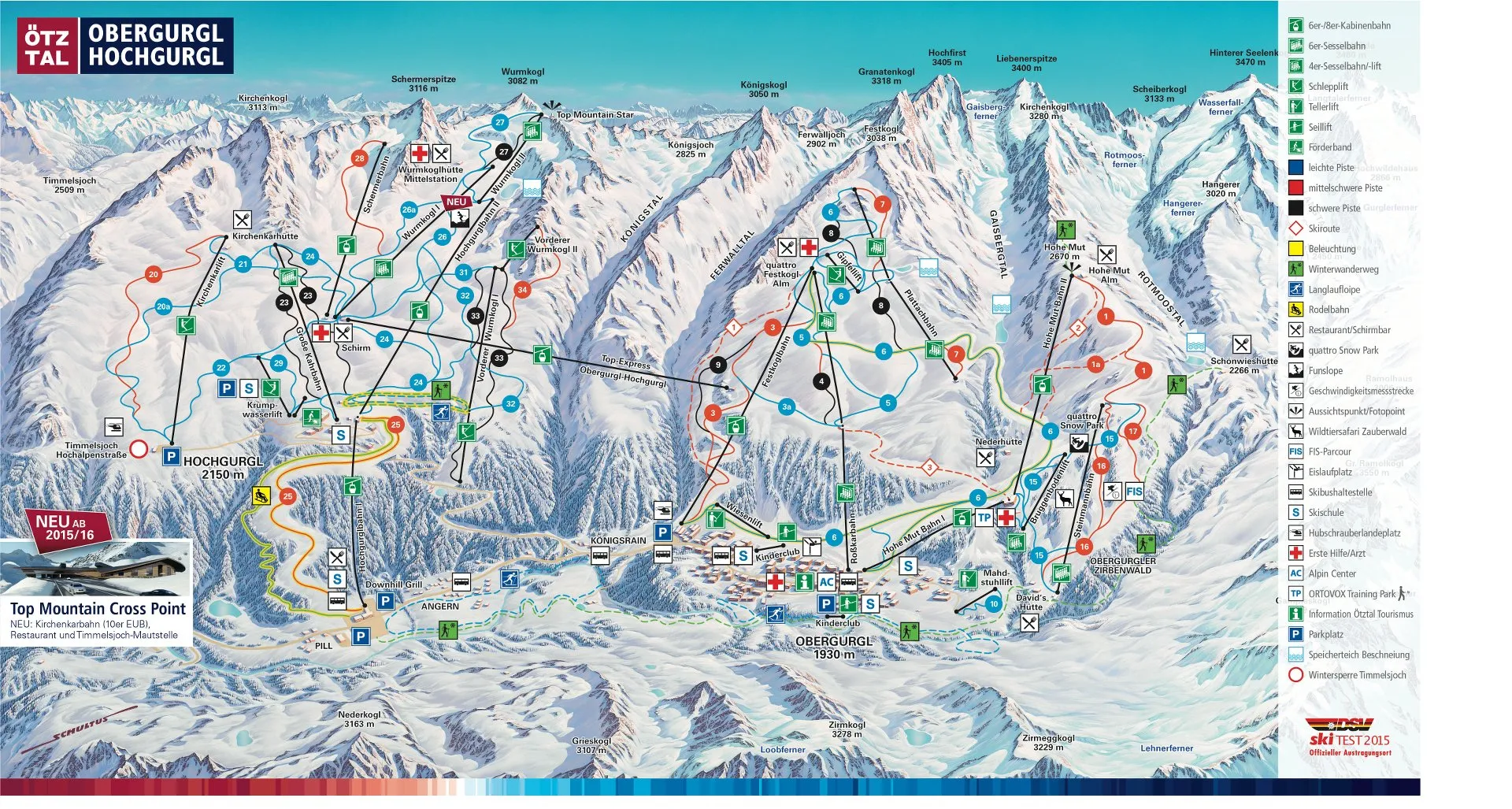
Slope Map
Resort Review
High-alpine, snow-sure, and comfortable: Gurgl (Obergurgl–Hochgurgl) offers 112 km of slopes with modern lift infrastructure, plenty of blue and red runs, and a seamless connection via the Top Express.
Advantages
- High, typically very snow-reliable altitude with an uncompromisingly high-alpine skiing experience (approx. 1,800–3,030 m)
- Excellent ski-link layout: Obergurgl and Hochgurgl are quickly connected via the Top-Express
- Perfect for families and leisurely skiers: plenty of blue and intermediate runs, plus playful fun areas
Disadvantages
- In windy or poor weather, the area can feel more exposed than forested ski regions
- The snowpark offering is geared more toward beginners and families; options for advanced riders are limited
- Après-ski is available, but more in scattered spots than as a “party-village” atmosphere
High-alpine instead of tree-lined descents: plenty of terrain above the treeline
Gurgl (Obergurgl–Hochgurgl) is an uncompromisingly high-altitude ski area with 112 kilometres of pistes and an elevation range of roughly 1,800 to 3,030 m. In practice, that usually means reliably grippy snow and a long winter season — but also this: in wind or bad weather, you’re more exposed here than in forested regions.
Two sectors you can truly ski: Obergurgl and Hochgurgl linked by the Top Express
The big advantage is the clear, intuitive logic of the ski link: Obergurgl and Hochgurgl are distinct areas (each roughly similar in size) and are connected via the Top Express (a panoramic ride of just a few minutes). That makes it easy to plan your day: sunny, cruisy slopes in the morning; more athletic options in the afternoon — without awkward valley transfers.
Strengths on skis:
- A strong mix of pistes, with plenty of easy and intermediate runs, plus purposefully steeper sections for experts.
- Comfort thanks to modern lifts and consistently high-quality infrastructure.
- Straightforward navigation: despite its size, the area remains easy to “read” and works well for groups.
A comfort-focused lift network: 25 lifts, minimal friction
With around 25 lift installations, the network is dense enough to keep queues and bottlenecks generally low. This fits the overall resort feel (many accommodations close to the action, with short morning starts and easy returns).
Freestyle as a fun set-up: great for beginners, limited for advanced park riders
Gurgl focuses less on a big pro-level park and more on several fun features: a Family Park (by the Bruggenbodenbahn) as well as fun slopes/fun cross for playful riding. The Family Park is explicitly beginner-friendly (boxes, small kickers) — ideal for first tricks and family groups with mixed ability.
Freeride as a structured option: designated runs, but an alpine mindset required
Off-piste, there are several documented freeride runs; some are demanding and require avalanche know-how (sometimes with notes calling for heightened attention/avalanche risk). If you don’t know the area, you’ll also find guiding services on site — a smart choice, as the terrain and conditions are distinctly high-alpine.
Family-friendly by design: lots of blue runs, learning zones, and an early start
For families, Gurgl works especially well thanks to its mix of many easy descents, clear meeting points, and well-developed learning options. Children’s ski lessons are typically offered from around age 3; beginner areas with magic carpets make starting out easier. The “Funmountain” concept also helps keep non-racer kids happily engaged.
Après-ski is more selective than everywhere-at-once: the Nederhütte as the fixed star
The après-ski scene is less “non-stop village party” and more concentrated on a few key spots. The Nederhütte is the best-known destination, with live music and that classic umbrella-bar atmosphere right in the ski area. Overall, Gurgl often feels a bit quieter and more hotel-oriented than the traditional party hotspots.
Variety beyond the pistes: winter hiking, tobogganing, and an unusual museum
Beyond skiing and snowboarding, winter hiking trails are a major draw, and there’s also a toboggan run (partly with uplift assistance). A further standout is the Top Mountain Motorcycle Experience (motorcycle exhibition) — a great bad-weather alternative or an ideal programme for a rest day.
Detailed Ratings
With 112 km of pistes, 25 lifts, and an altitude range reaching roughly 3,030 m, Gurgl is extensive enough for several days and excels in snow reliability and comfort. The Obergurgl–Hochgurgl link delivers a tangible sense of “flow.” In storms or whiteout conditions, however, the high elevation can become a drawback.
Several fun setups (family park, fun slopes, fun cross) offer plenty of variety for beginners and families. Those looking for a large, progressive park for advanced riders will find a more playful, laid-back experience here rather than a competition-driven setup.
Freeriding is a great option as a complement: there are designated runs as well as classic high-alpine faces. Even so, the terrain demands respect, avalanche know-how (or a guide), and good visibility.
Very family-friendly thanks to dedicated learning areas, a wide choice of gentle blue runs, and well-organized meeting points. Children can start ski lessons early (typically from around age 3), and fun parks keep motivation high beyond the classic beginner slopes.
Après-ski is available, but not everywhere. The Nederhütte is the central, well-known meeting point with music and a lively umbrella-bar vibe; beyond that, Gurgl as a whole is comparatively quiet and geared toward comfort.
Winter hiking and sledding are solid alternatives, and the Motorcycle Museum (Top Mountain Motorcycle Experience) adds an unusual bad-weather option. For a true day of wellness or shopping, most people also plan day trips into the surrounding area.