Ski Arlberg (St. Anton – Lech – Zürs)
Piste Overview
Blue
130 km (43%)
Red
120 km (40%)
Black
49.7 km (17%)
Ski Route
200 km
Total: 300 km
Lift System
Gondolas
Chairlifts
T-Bar Lifts
Aerial Trams
Total: 84 lifts
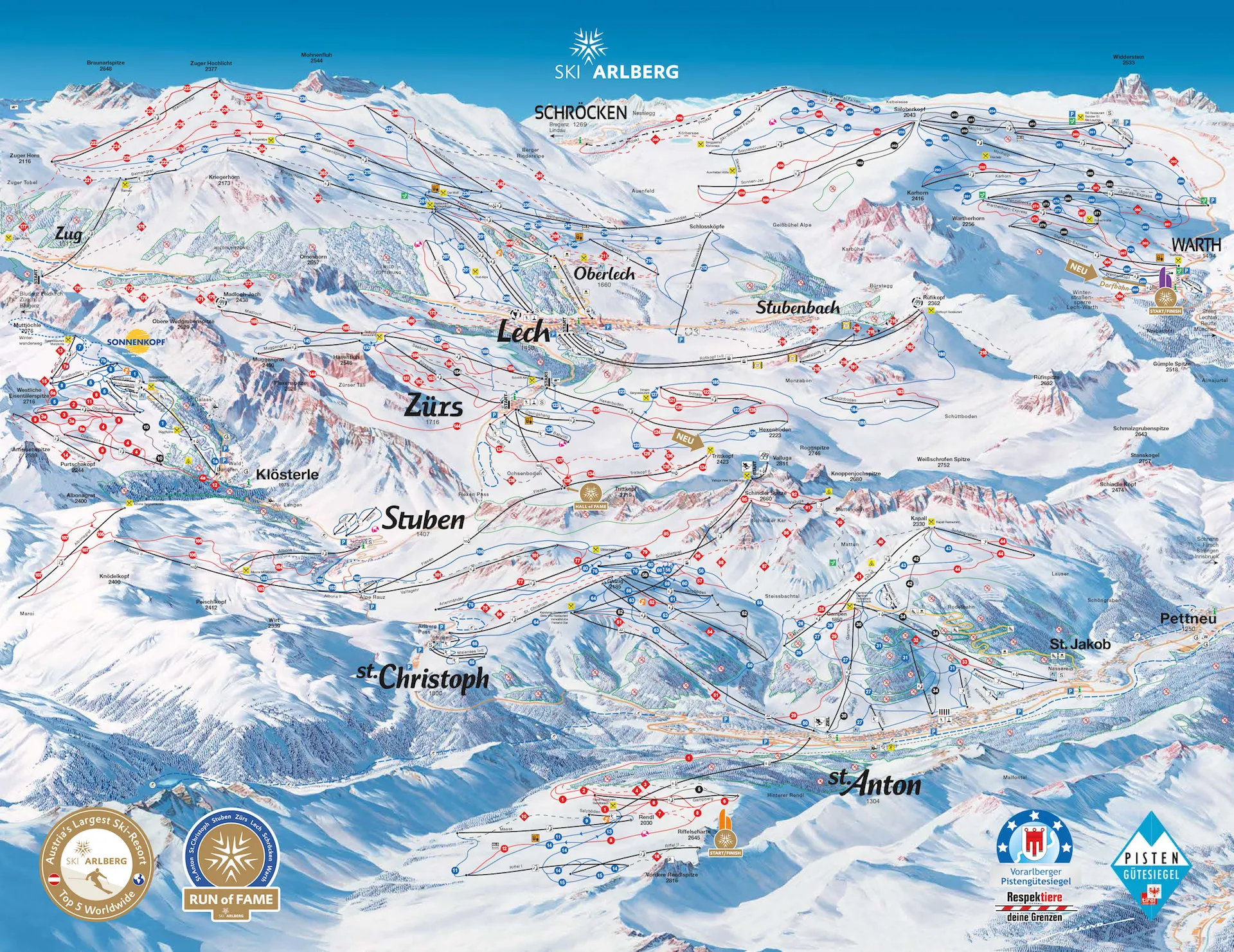
Slope Map
Resort Review
Ski Arlberg is Austria’s largest interconnected ski area: 300 km of pistes (1,304–2,811 m), exceptionally strong for freeriding, with top-notch freestyle at Rendl and a very vibrant après-ski culture in St. Anton.
Advantages
- Very large, contiguous ski area (300 km) with plenty of distinct “day-trip personalities” depending on the sector.
- Top-tier freeride offering (as communicated: >200 km of itineraries) plus safety infrastructure.
- A strong freestyle mix: Stanton Park on Rendl (3 lines) + a Family Park/Funslope in Lech.
Disadvantages
- Size takes time: without planning, it’s easy to lose many minutes to connections and backtracking.
- St. Anton is decidedly sporty and lively—on the slopes as well as après-ski—and not everyone is looking for exactly that kind of buzz.
- High-alpine freeride terrain demands real know-how; iconic objectives like the Valluga are not a “standard” piste affair.
A ski area the size of a region: vast, seamless—and still clearly divided into distinct “sectors”
Ski Arlberg links St. Anton, Lech, Zürs (plus Stuben and Warth-Schröcken) into a truly interconnected ski circuit with 300 km of pistes, 85 lifts, and an elevation range from 1,304 m to 2,811 m. That isn’t just “a lot”—it’s practical: over several days, you can shift your ski day into different sectors depending on weather, ability and mood, without ever having to change resorts.
Skiing with long-distance options: huge variety, but the scale demands planning
The piste mix runs from relaxed to athletic—its character noticeably different from village to village: St. Anton is generally steeper and more powerful, attracting sporty skiers, while Lech/Oberlech offers plenty of pleasantly skiable slopes and excellent cruising loops.
For strong skiers, the “Run of Fame” (a ski circuit spanning the entire area) is a quintessential Arlberg day: long, varied, and physically demanding.
What to be prepared for:
- Long distances: if you want to “just pop over,” it’s better to set firm day goals (otherwise you’ll lose time in transfers).
- Return routes can be challenging depending on time of day/traffic—especially in St. Anton, the reality of skiing back to the valley isn’t always a beginner’s dream.
Freeride is a core strength—with a real respect factor and solid safety infrastructure
The Arlberg is one of the Alps’ premier freeride destinations: beyond the pistes, more than 200 km of high-alpine powder descents/backcountry variants are promoted, supported by info points, transceiver search areas, and training offers.
Important: this is high-alpine terrain, and the decisions are often serious. A symbolic example is the Valluga: Valluga cable car II carries passengers only without skis—a clear signal that this isn’t a standard piste run, but terrain that requires know-how/guiding and well-judged timing.
Freestyle in two tiers: the scene park on Rendl plus family-friendly funparks in Lech
Freestylers will find the stanton park on Rendl with 37 obstacles and three lines (Beginner/Advanced/Pro)—a setup that works from first turns to truly ambitious riding.
If you prefer something more playful (or you’re travelling with children), Lech offers fitting alternatives: Familypark and Funslope for beginners/families, plus a snowpark with more challenging lines at Schlegelkopf.
Families: excellent infrastructure—most relaxed when you choose the right zones
For families, the area really shines when you use it not as a “300 km project,” but as a collection of strong sub-areas: practice zones, kids’ programmes and ski schools are available in multiple villages; in St. Anton, for example, offerings from age 3 are described (with childcare available even earlier).
Practical family tip: first choose a “home sector” (e.g. Oberlech/Schlosskopf or Nasserein/Gampen), then plan excursions to other sectors as clear day itineraries.
Après-ski: St. Anton is loud, visible and early—Lech/Zürs usually more refined
If après-ski is a core part of your holiday, St. Anton is the place to be: the MooserWirt is firmly established as a cult spot, and the atmosphere often kicks off as early as the afternoon.
Lech/Zürs, by comparison, often feels more elegant and less “party first”—ideal for groups who’d rather enjoy a quiet dinner in the evening or sit at the bar.
Balance beyond the pistes: wellness, indoor sports, winter hiking and tobogganing
For bad-weather days or recovery, there’s plenty on offer:
- Arlberg WellCom (pool/sauna/wellness) in St. Anton.
- arl.park in St. Anton (climbing/bouldering and other indoor activities).
- Winter hiking around Lech/Zürs (also guided).
- Tobogganing in Lech (Oberlech–Lech) as an easy family activity.
Detailed Ratings
With 300 km of pistes, 85 lifts, and a wide altitude range, Ski Arlberg is a true multi-day destination. Its sub-areas feel distinctly different (St. Anton more athletic, Lech/Oberlech often more rounded), which keeps the variety high. Connectivity is excellent—yet it still pays to plan your day routes deliberately.
The Stanton Park on Rendl is the standout highlight: three lines (from beginner to pro) and an extensive obstacle setup. To round things out, the funparks in Lech offer a very approachable entry via the Family Park and the Funslope—ideal for mixed-ability groups.
Freeriding at Arlberg isn’t an add-on—it’s in the resort’s DNA: more than 200 km of high-alpine off-piste routes are promoted, along with information and training opportunities focused on safety. At the same time, the terrain is demanding; areas like the Valluga are emblematic of “only with a plan and the right know-how.”
The infrastructure for children is extensive (several kids’ areas/practice zones, ski schools, adventure activities). Families have the most relaxed time if they choose a suitable “home sector” and take the big ski circuit in measured doses.
St. Anton is right at the very top when it comes to après-ski: legendary spots like the MooserWirt define the village, and the atmosphere often kicks off as early as the afternoon. Lech/Zürs, by contrast, offers a quieter, more stylish alternative.
With WellCom (wellness/swimming/sauna), arl.park (climbing/bouldering), as well as winter hiking and tobogganing options, the region offers plenty to do away from the slopes too—enough to fill entire days with meaningful activities.