Piste Overview
Blue
46.5 km (32%)
Red
88 km (60%)
Black
11.8 km (8%)
Ski Route
3.4 km
Total: 146 km
Lift System
Gondolas
Chairlifts
T-Bar Lifts
Aerial Trams
Total: 52 lifts
Slope Map
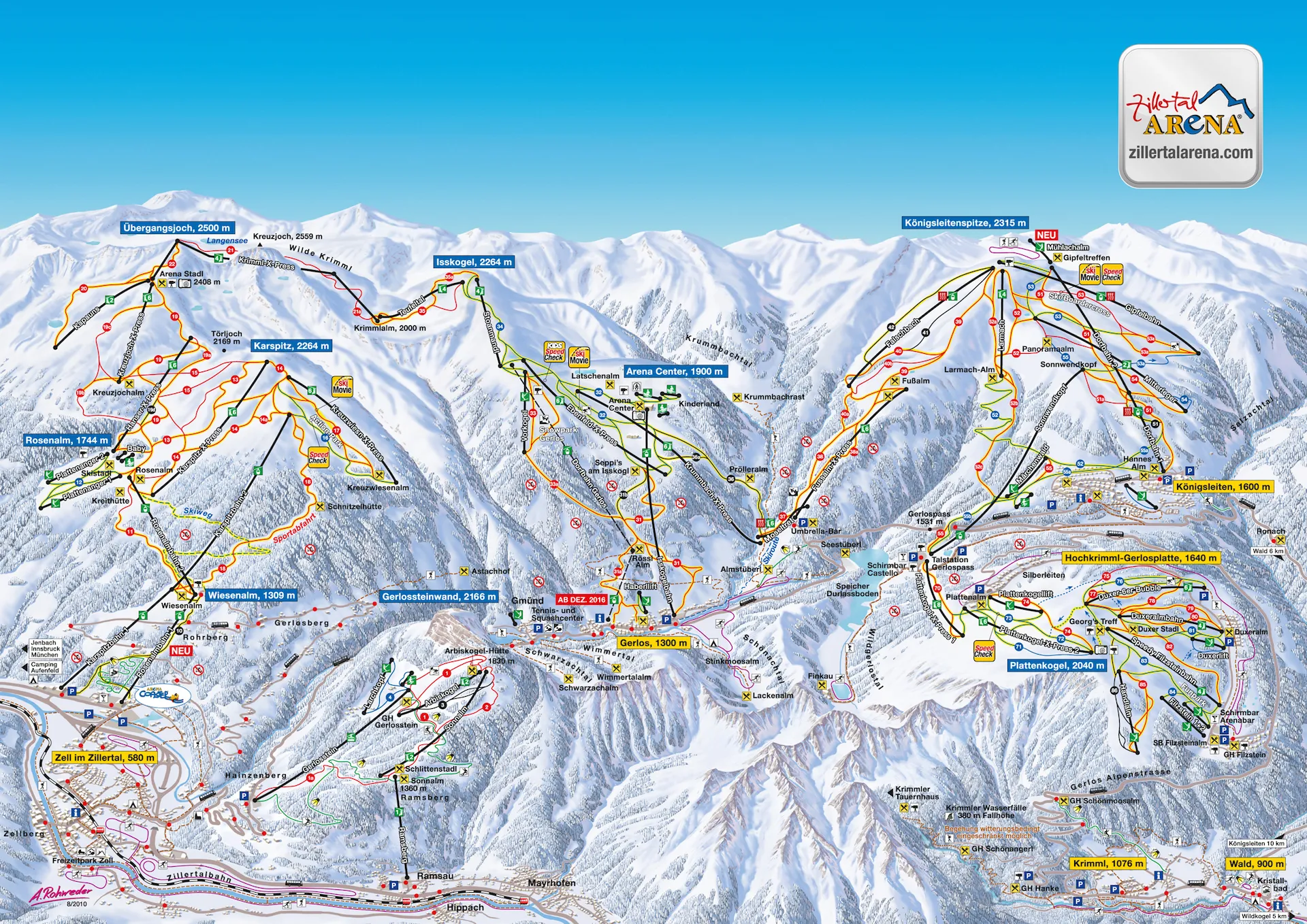
Resort Review
A vast ski circuit between Tyrol and Salzburg, offering around 150 km of pistes, multiple access points (Zell–Gerlos–Königsleiten–Hochkrimml), and a clear focus on families, freestyle, and après-ski in Gerlos.
Advantages
- Large, interconnected area with plenty of access points and excellent “circuit tour” planning (Zell–Gerlos–Königsleiten–Hochkrimml).
- A compelling all-round package for families and freestyle fans (several parks/action offerings, many ski school options).
- Gerlos delivers a vibrant après-ski scene; away from the slopes, there’s a solid choice of activities (tobogganing, coaster, cross-country skiing).
Disadvantages
- No glacier; snow reliability is ensured by altitude and snowmaking (during very warm spells there is less of a “high‑alpine buffer” than in glacier resorts).
- One section of the resort (Gerlosstein/Hainzenberg) is not connected by pistes and can only be reached by ski bus.
- For complete beginners, the size of the area—and the need to move between its different sectors—can feel confusing at first, especially if you try to ski “across” the resort without a plan.
From Zell to Hochkrimml: a linked ski circuit with plenty of entry points and a clear “day-tour” logic
The Zillertal Arena is a vast, interconnected ski region stretching from the Zillertal (Tyrol) all the way to the Pinzgau (Salzburg). With around 150 kilometres of pistes, an altitude range of approx. 580–2,500 m, and 52 lifts, it’s big enough for several full ski days—yet its main axes keep it easy to grasp, including the well-known “Arena Tour” as a continuous loop across the different sectors.
Skiing: lots of blue/red, long descents – and modern capacity on the main routes
Rather than being defined by “only difficult” terrain, the area shines with wide, often sporty cruising runs and a very large choice in the intermediate range. Variety comes from the distinctly different characters of the sectors (Zell/Isskogel, Königsleiten, Gerlosplatte/Hochkrimml) as well as several valley runs.
A clear plus: the Arena regularly invests in comfort and connection quality (including modern chairlifts with weather-protection bubbles/seat heating, as well as upgrades to key access lifts). That reduces peak queues and makes it easier to keep moving throughout the day.
One limitation worth planning for: part of the offering (e.g. Gerlosstein/Hainzenberg) is included in the overall network, but is not connected by piste and can only be reached by ski bus—relevant for some weekly itineraries.
Snow reliability without a glacier: altitude plus snowmaking as a “planning” factor
There is no glacier here—the Zillertal Arena’s snow reliability rests primarily on its high-altitude terrain up to 2,500 m and a large share of snowmaking-covered pistes. That generally makes the area far more predictable than many lower, forest-bound ski hills, without positioning itself as an extreme high-alpine destination.
Freestyle isn’t “just an add-on”: Action Park, Snowpark Gerlos, and a small fun park for beginners
Freestylers will find several clearly separated options across the Arena:
- Action Park Kreuzwiese (Zell) with features such as a fun/snakerun, bagjump training, and additional “play stations” (e.g. SkiMovie/Speed Check).
- Snowpark Gerlos, the classic park setup in the area, with lines for different levels (typically ranging from first tricks to more athletic jumps/obstacles).
- Funpark Hochkrimml, a smaller, beginner-friendly setup—more “learn & find your feet safely” than a contest arena.
Freeride: mainly off-piste variations close to the pistes – with marked ski routes as an entry point
For freeride days, the Zillertal Arena is best when you’re looking for variations beside the piste (e.g. after fresh snowfall) and planning the day as a mix of piste/sidecountry. As an officially designated complement, there are ski routes (marked, but still alpine terrain). As always: avalanche conditions, visibility, and local guidance determine what makes sense; anyone wanting more than “just a quick drop beside the piste” benefits from local knowledge or a guide.
Families: strong children’s infrastructure – easiest with clear meeting points
Families benefit from the wide selection of easy/intermediate runs, multiple entry points into the area, and a visible focus on children’s offerings (including Funty as the mascot, playful children’s elements on selected runs, plus ski school/kindergarten structures). The number of ski schools is also high, which usually makes course planning easier.
Practical tip: given its size and the transitions between sectors, the area can feel like “too much” at first for absolute beginners in a group—set meeting points and a day plan (one sector rather than “across everything”) make it noticeably more relaxed.
Gerlos as the atmosphere engine: après-ski from umbrella bars to clubs
If après-ski is a top criterion, Gerlos is the central anchor within the Arena. Typical are ski-in locations in/near the ski area (e.g. large umbrella-bar formats), followed later by moving on to bars/clubs in the village. Those who prefer things quieter will usually find a more laid-back counterpoint in the other towns.
Beyond the pistes: sledging, coaster, cross-country skiing and winter hiking as real alternatives
Alongside skiing, the Arena stands out for how “full” it is of additional activities:
- Tobogganing (including the long Gerlosstein run, plus further toboggan options in the villages).
- Arena Coaster in Zell am Ziller as a weather-independent action highlight for families and groups.
- Cross-country skiing (including the valley trail in Zell) and classic winter hiking options, depending on location/snow conditions.
Detailed Ratings
Around 150 km of slopes spread across several sectors offer plenty of variety, especially in the blue and red range. The main arteries are well developed and, thanks to ongoing modernisation, are becoming ever more comfortable. With no glacier, altitude—up to 2,500 m—remains the key factor for reliable snow.
With the Action Park Kreuzwiese, the Snowpark Gerlos and a smaller fun park in Hochkrimml, freestyle is a visible, firmly rooted part of the area. The setup is especially well suited to groups, as beginners and more advanced riders alike will find sections that fit their level.
There are marked ski routes and classic off-piste variants alongside groomed runs—ideal for “sidecountry” days after a fresh snowfall. For true backcountry touring, take avalanche conditions and navigation seriously; the area is more versatile than extreme.
Plenty of easy to intermediate runs, several villages to use as a base, and a clear family focus (kids’ zones, fun elements, and a well-developed ski school setup). It’s most relaxed if you set fixed meeting points and a sector plan for each day.
Gerlos is the Arena’s après-ski hotspot—with ski-in meeting places and a programme that carries on well into the evening. In Zell/Königsleiten/Hochkrimml, by contrast, things are usually much quieter.
Tobogganing (including the long Gerlosstein lift), the Arena Coaster, cross-country skiing and winter hiking also make the Arena an appealing choice for rest days or mixed-ability groups. The range of activities is sensibly spread across several locations.