Piste Overview
Blue
47 km (20%)
Red
140 km (59%)
Black
52 km (22%)
Ski Route
15 km
Total: 239 km
Lift System
Gondolas
Chairlifts
T-Bar Lifts
Aerial Trams
Total: 41 lifts
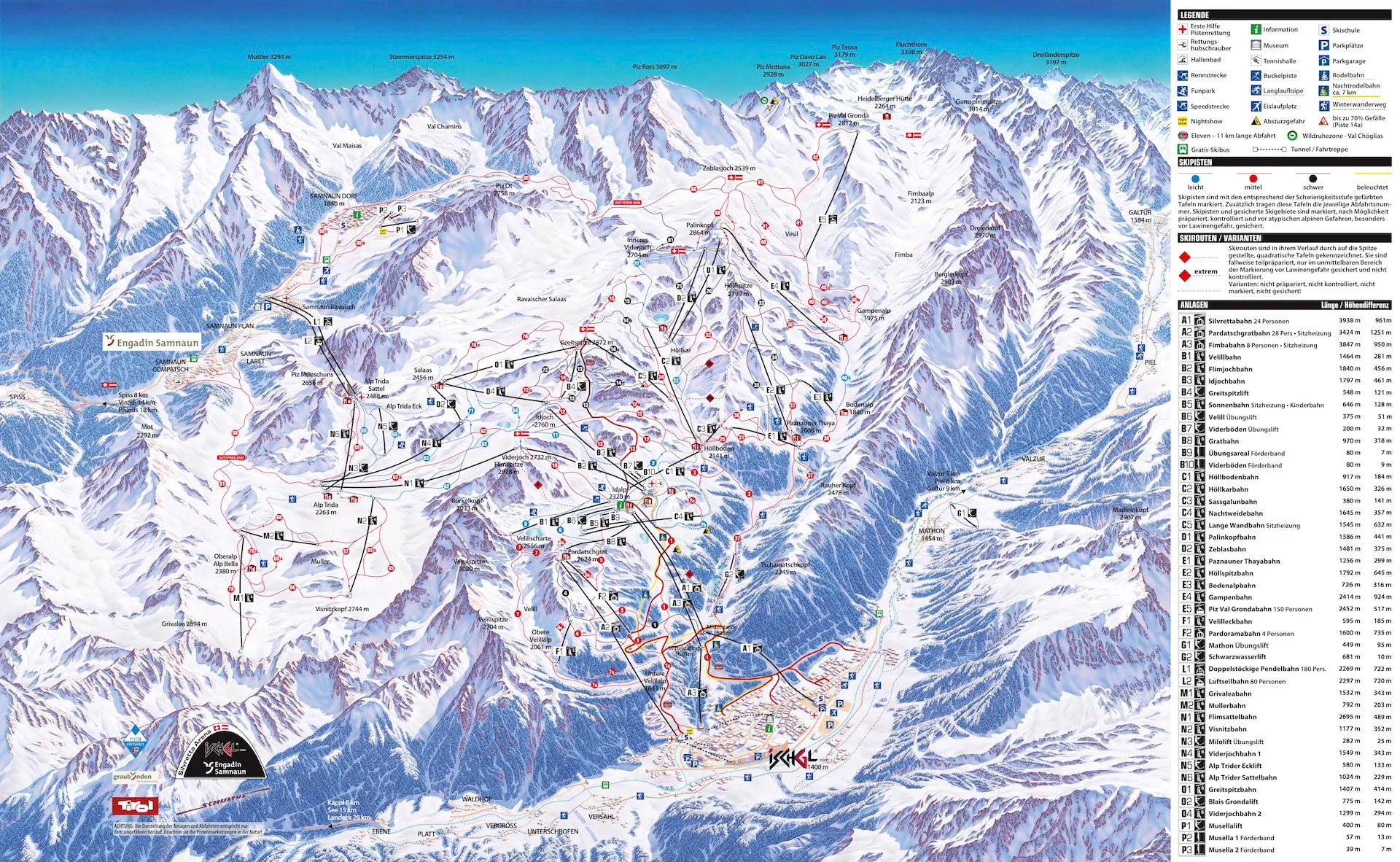
Slope Map
Resort Review
Vast, cross-border ski circuit with 239 km of slopes (1,360–2,872 m): sporty skiing “in the flow,” legendary après-ski in Ischgl, plus duty-free shopping in Samnaun.
Advantages
- Very large cross-border ski area (239 km) with a wide high-altitude range (1,360–2,872 m) and excellent ski-touring opportunities
- A compelling all-round package: lively après-ski in Ischgl + the quieter Samnaun with duty-free shopping
- Plenty of off-slope infrastructure: Silvretta Therme, winter hiking, and an 80 km cross-country network in the region
Disadvantages
- For beginners, the area (with its emphasis on red runs) can quickly feel “too much” if you don’t focus on the right zones.
- As a top destination, it’s often in high demand: along the main arteries and at peak times, it can get crowded.
- In the evenings, Ischgl is decidedly party-minded—anyone seeking absolute tranquillity should choose their accommodation location with care.
Two countries in one ski area: skiing all the way to a duty-free detour
The Silvretta Arena Ischgl–Samnaun is a cross-border ski circuit (Austria/Switzerland) with plenty of terrain and clear navigation: anyone who enjoys long days on snow can plan tours and loops—right up to the Smugglers’ Loop, a signposted ski circuit.
Beyond skiing, the combination of Ischgl’s dense après-ski scene and Samnaun’s duty-free shopping is a true unique selling point: two villages, two atmospheres—on the very same ski day.
Lots of piste, little downtime: big, well connected, with a sporty bias
With 239 km of slopes plus 15 km of ski routes, and an altitude range from 1,360 m to 2,872 m, the area is clearly geared toward mileage-hungry and sporty skiers. The focus is on red runs (significantly more than blue/black), making it ideal for groups with solid technique.
What delivers day to day:
- Interconnected ski-circuit logic with plenty of sensible links between sectors
- High-alpine pistes for more reliable conditions than classic forest/valley terrain
- Modern lift infrastructure (comfortable 8-seater chairs with weather hoods/seat heating are typical)
Freestyle without a barrier to entry: park, funline and “try & progress”
The Ischgl Snowpark is designed so that it’s not only advanced riders who find what they’re looking for: there are two park areas, a funline, plus extras such as bag jump and speedline.
Practical: a playful funline (with lots of small features) makes it easy to weave freestyle into your ski day—even when not everyone in the group is “park-focused.”
Freeride as a clear headline: Piz Val Gronda & more
In Ischgl, freeride isn’t an afterthought: the standout terrain is Piz Val Gronda (2,812 m); the Ravaischer Salaas area is also cited as a freeride zone. Some entry points are close to the piste, which makes finding your way easier.
The alpine character still rules: visibility, avalanche conditions and route choice decide whether it’s a blissful run—or a safety problem.
Families: kids’ zones as fixed points—despite a “big” ski area
For families, the arena works well if you structure the day:
- In Ischgl, there’s a ski kindergarten (from age 3) and large ski-school operations on the Idalp.
- In Samnaun, a dedicated kids’ area with conveyor belts/magic carpets is established as a clear, contained practice zone.
The size of the area is more advantage than drawback—as long as meeting points and “loops” are agreed on clearly.
Après-ski & rest days: Ischgl louder, Samnaun quieter—plus a spa
Ischgl is one of those places where après-ski is part of the overall concept (classic names in town include the Kuhstall and Trofana Alm; on the mountain, the Paznauner Taja). Samnaun generally feels noticeably quieter by comparison.
For non-ski days—or for recovery after long descents—the Silvretta Therme Ischgl is a compelling reason to stay (a large pool landscape, extensive sauna area). In addition, the region offers winter hiking/snowshoe routes and a cross-country network (80 km) between Ischgl and Galtür.
Detailed Ratings
With 239 km of pistes plus 15 km of ski routes, the arena is large enough for several days of variety. The altitude range (1,360–2,872 m) and the excellent interconnection of the sectors make for long ski days without constant replanning. The overall character is decidedly sporty, with a clear emphasis on red runs.
The Snowpark features two park zones, a funline, and additional offerings such as a bag jump and speedline. With clearly designated features (including boxes and fun tubes), the setup is ideally suited for everyone from beginners to advanced riders.
With Piz Val Gronda (2,812 m) and Ravaischer Salaas, there are clearly designated freeride areas—some with access points close to the piste. The terrain is truly high-alpine and, despite its easy accessibility, demands a sound assessment of conditions and risk.
Families benefit from dedicated children’s areas and extensive ski school programmes (including the ski kindergarten in Ischgl and the children’s snow park in Samnaun). Thanks to clearly defined meeting points, the sheer size of the ski area is easy to manage—though without a bit of planning it can feel confusing.
Ischgl is one of the Alps’ best-known après-ski hotspots—boasting standout venues in town (e.g. Kuhstall, Trofana Alm) as well as on the mountain (Paznauner Taja). Those seeking peace and quiet are more likely to find it in Samnaun or away from the main hubs.
With the Silvretta Therme (pool and sauna world), Ischgl boasts a true bad-weather and recovery highlight. Add to that winter hiking and snowshoe routes, duty-free shopping in Samnaun, and an 80 km cross-country skiing network across the region.