Piste Overview
Blue
30 km (27%)
Red
69 km (63%)
Black
11 km (10%)
Ski Route
0 km
Total: 110 km
Lift System
Gondolas
Chairlifts
T-Bar Lifts
Aerial Trams
Total: 24 lifts
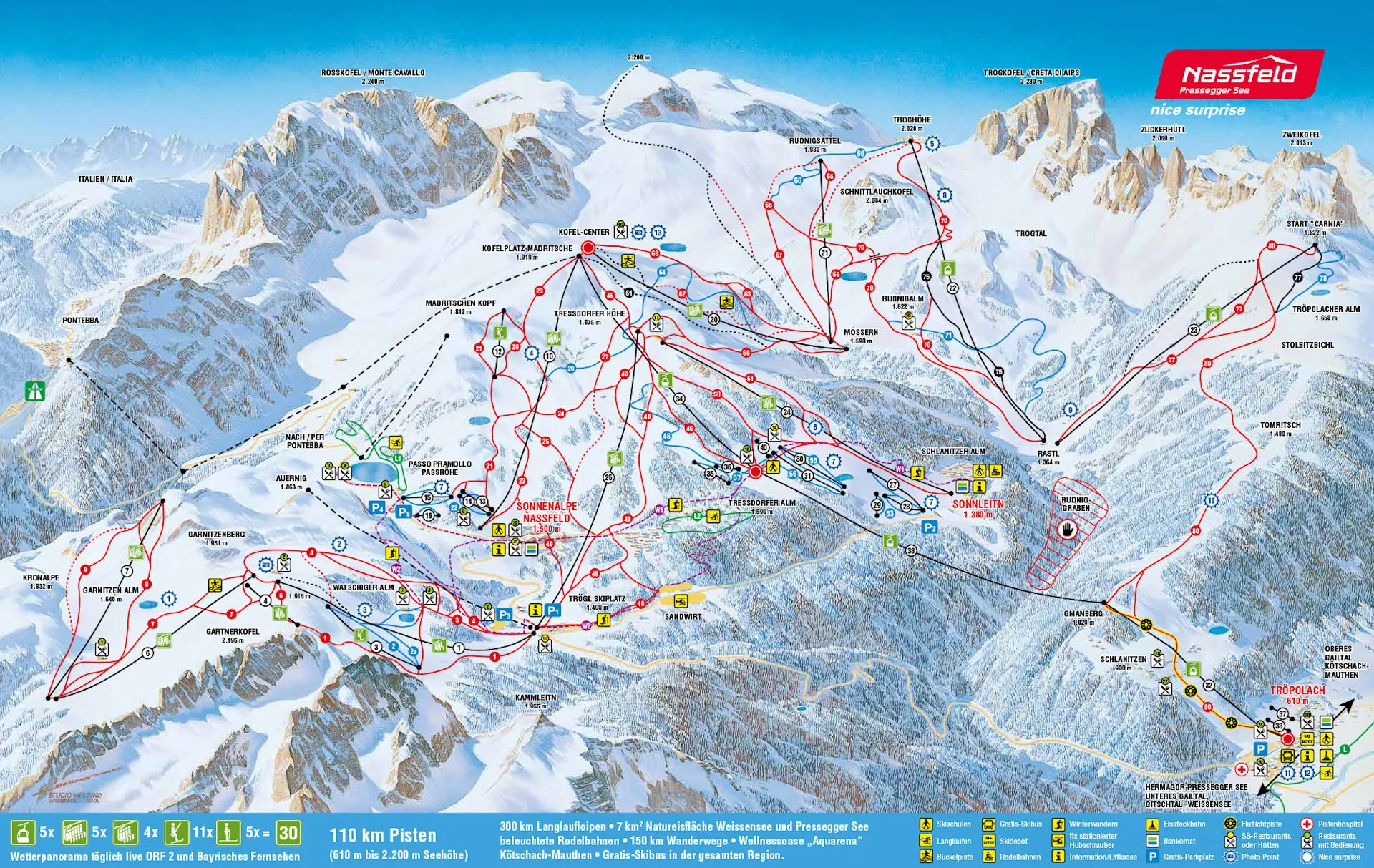
Slope Map
Resort Review
Nassfeld–Hermagor is a sunny, spacious ski area on the Italian border, offering 110 km of pistes, a strong selection of intermediate runs, a solid snowpark, and a wide range of off-slope activities around Lake Pressegger.
Advantages
- Wide, sporty runs with a strong intermediate offering (plenty of “reds”) and 110 km of pistes in total.
- Excellent snow reliability thanks to a southerly weather window plus extensive snowmaking; a modern lift and access concept featuring the Millennium Express.
- A great all-round package for mixed groups: a snowpark with multiple lines, family hotspots, and plenty of off-slope activities (tobogganing, cross-country trails, ice on the lake).
Disadvantages
- No glacier; the very low-lying valley sector can become more demanding in mild weather or when fresh snow is scarce than the high-alpine terrain.
- The return to Tröpolach depends heavily on the valley run/connection (“Carnia”)—it can bottleneck at peak times.
- Après-ski is available, but more spread out and less “village-centered” than in full-blown party resorts.
Sunny border location with “wide-open pistes”: plenty of space, plus an Italian flair
Nassfeld–Hermagor (Carinthia) is a generously sized ski area on the southern side of the Alps—known for broad slopes, lots of sunshine, and a blend of Austrian and Italian character (set right on the border; parts of the ski area lie in Austria and Italy).
With 110 km of pistes and 29 lifts, it’s large enough for several varied days without your ski day having to feel like “sector-hopping.” The elevation range spans around 600 m to 2,002 m.
Sporty skiing at its core: lots of reds, a smart layout, a strong feeder lift
A defining feature is the high share of intermediate (red) runs: of the 110 km, 30 km are easy, 69 km intermediate, and 11 km difficult. This suits confident leisure skiers in particular—those who love long carving slopes without needing to rely on black runs all day.
The main access point is the Millennium Express from Tröpolach (multiple sections)—convenient if you’re staying close to the valley, and also a clear “main corridor” into the ski area.
Important for day planning: the long valley run “Carnia” (7.6 km) is, according to standard area information, the valley connection/route back to Tröpolach—when it’s busy, that can funnel the return journey.
Snow reliability via microclimate and snowmaking—without glacier backup
Nassfeld is considered snow-reliable thanks to its southern weather window (Adriatic lows/microclimate) and also relies on extensive snowmaking (a figure on the order of around 540 snowmaking units is commonly communicated). There is no glacier here as a safety net—snow cover at the very lowest elevations is, naturally, more weather-dependent than in high-alpine glacier areas.
Snowpark with three lines: sensibly tiered, easy to weave in as a “side program”
The Snowpark Nassfeld sits in the Gartnerkofel/Watschiger Alm area and is designed with three lines for different ability levels (from beginner to advanced), with an emphasis on kicker and jib features (boxes/rails, etc.). That makes it a great option for groups where not everyone wants to spend the whole day in the park.
Freeride as an option: variants around striking slopes—with alpine respect
Off-piste, Nassfeld is mainly described in terms of marked powder/fun or freeride areas and route variants (classic mentions include zones on prominent faces such as around Trogkofel and the Rudnigsattel). It’s not a high-alpine “freeride mecca,” but it’s a worthwhile extra on days with the right conditions. Avalanche situation, visibility, and terrain shape remain decisive—local knowledge or guiding is well worth it for genuine off-piste plans.
Families work well—if you orient yourself around the hotspots
For families, Nassfeld scores with practice areas, ski school infrastructure, and clear meeting points—especially around the Tressdorfer Alm / mid-station (a family-oriented zone with lots of playful elements) as well as other beginner sectors. Childcare/kids’ offers (e.g., the BOBO concept) are also present, making logistics with younger children easier.
Après-ski is more “spread out”: umbrella bars up top, valley-station atmosphere below
Après-ski is available, but less “concentrated” than in classic party resorts: in the ski area (including around Sonnenalpe) you’ll find umbrella bars and mountain huts, and at the valley station in Tröpolach there are additional bars for winding down. Overall, the offering is solid—the vibe ranges from cosy to livelier, without dominating the entire area.
Strong supporting programme: cross-country trails, winter hiking, tobogganing, and natural ice on the lake
Away from the pistes, the region is broadly positioned: cross-country trails (including around 80 km in the region), winter hiking paths, and tobogganing options are promoted; and—when temperatures allow—ice skating/ice stock sport on Lake Pressegger See adds a wintry counterpoint.
Detailed Ratings
With 110 km of slopes, Nassfeld offers a very coherent mix, with the emphasis on red runs—often wide—and a satisfying sense of “flow” between its different areas. The Millennium Express is a strong main access lift, though the routes back down into the valley funnel into just a few corridors. Snow reliability comes from a favorable microclimate and powerful snowmaking, not from glacier altitude.
The snowpark at Gartnerkofel/Watschiger Alm is clearly laid out, with multiple lines thoughtfully graded to suit every ability level. It’s an ideal add-on to your daily skiing routine – from your very first jib to more athletic kicker setups.
At Nassfeld, freeriding is offered as an addition in the form of designated areas and variant slopes (including near prominent pistes). For true off-piste days, the rule is: think alpine, take the avalanche situation seriously, and when in doubt, plan with local support.
Families will find several dedicated practice and ski school areas, as well as clearly defined meeting points (including at the mid-station/Tressdorfer Alm). This makes even a large area easy to plan with children—ideally with clear daily goals for each sector.
Après-ski is available – with umbrella bars and mountain huts in the ski area, plus further options down in the valley near Tröpolach. The vibe is more “local & laid-back” than distinctly party-focused.
A strong range of alternatives, with cross-country ski trails, winter hiking and tobogganing. An additional highlight—when temperatures are low enough—is the natural-ice experience on Lake Pressegger (ice skating/ice stock sport).