Piste Overview
Blue
86.1 km (59%)
Red
50.3 km (35%)
Black
8.4 km (6%)
Ski Route
3 km
Total: 145 km
Lift System
Gondolas
Chairlifts
T-Bar Lifts
Aerial Trams
Total: 45 lifts
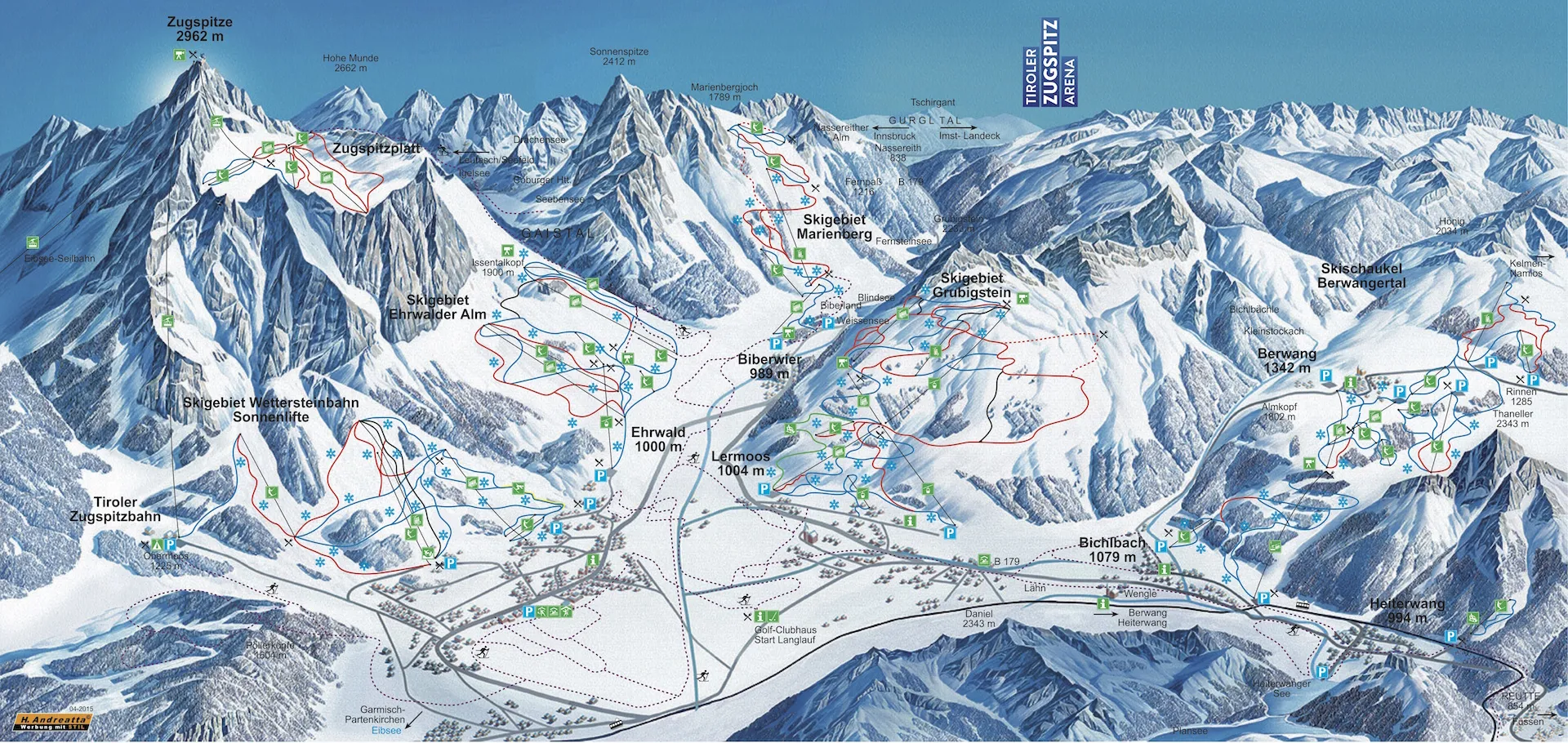
Slope Map
Resort Review
A versatile ski region around the Zugspitze: several sub-areas covered by a single lift pass, with plenty of gentle blue and red runs for relaxed skiing and families—plus the high-alpine Zugspitzplatt. Switch between the mountains by ski bus.
Advantages
- A wealth of variety with several ski areas under one ski pass – from gentle family slopes to the high-alpine Zugspitzplatt.
- Family-friendly infrastructure with practice areas, children’s parks, and ski school options that are easy to make the most of.
- A strong line-up beyond the pistes: an extensive cross-country network (partly free of charge), sledding, and winter hiking.
Disadvantages
- No continuous lift link between the individual sectors – switching takes time (ski bus/car).
- For very athletic experts, the challenge within each sector can feel limited over time; the variety comes more from changing locations.
- Après-ski is on the quieter side; those looking for a party will only find a few occasional spots that fit the bill.
Many mountains instead of one linked ski circuit: ideal for variety, less so for “endless carving”
The Tyrolean Zugspitz Arena isn’t a single, continuously lift-linked ski circuit, but a region made up of several ski areas around Ehrwald, Lermoos, Biberwier and Berwang. The big plus: with one lift pass you get lots of variety across different slopes and aspects—though switching “playgrounds” happens by ski bus/car, not via piste connections.
With a total of around 143 km of pistes and an altitude range of roughly 1,000 to 2,962 m, the offer is broad: from gentle family slopes to a few sporty sections—and, as a standout, high-alpine skiing on the Zugspitzplatt.
Snow reserve thanks to altitude and snowmaking: the Zugspitze as a joker, the valleys as the variable
The region benefits from its altitude (up to just under 3,000 m) and a large share of snowmaking-equipped pistes. This makes the Zugspitz Arena overall fairly resilient, even if the lower valley sectors are, naturally, more dependent on temperature and weather.
If you want to maximise snow reliability, plan your day deliberately:
- in changeable conditions, aim for the higher-lying sectors
- build in the Zugspitzplatt as an option for truly wintry, high-alpine days
Skiing for pleasure, families and confident intermediates: plenty of space, clear piste logic
On-piste strengths are the easy-to-read sub-areas and the generally family- and enjoyment-oriented character of many runs. At the same time, there’s enough variety for several days—especially if you switch between the different ski mountains.
What works particularly well for skiing:
- Beginners & returners: lots of easy, wide slopes and practice zones
- Cruisers: long, rhythmic descents (including in Lermoos)
- Sporty variety: a few steeper/more demanding piste sections (e.g. panorama variants)
Limitation: anyone looking for a large, continuous “ski-the-circuit” experience without changing location will feel the commute between ski areas as a break in the ski day.
Freestyle is well spread across the region: Betterpark as the hub, plus fun areas
The clearest freestyle focus is on the Ehrwalder Alm with the Betterpark: multiple lines for different levels make it appealing for mixed groups (beginners to advanced).
In addition, you’ll find further, more compact/playful setups across the region:
- fun elements and smaller fun runs (depending on the sub-area)
- additional park and obstacle offerings (including on the Wetterstein and in Berwang)
Freeride is more “targeted” than extensive: routes/variants, yes—yet with an alpine character
Freeride plays a role, but it’s not a consistently dominant theme as in classic freeride destinations. There are freeride/ski routes and variant slopes (including in the Wetterstein sector as well as select powder zones across the region). Close to the Zugspitze there are also well-known, alpine classic descents, which in practice are often tackled with a guide.
Important: the terrain can be high-alpine and complex—avalanche conditions, visibility and local navigation are crucial here.
Family-friendly with clear anchors: children’s areas, ski schools, short distances
Families are very well catered for in the Zugspitz Arena, especially in the areas around Ehrwald and Biberwier:
- children’s and beginner areas with conveyor belts/magic carpets
- family and fun elements (e.g. family park, funslope)
- several ski schools and well-organised meeting points
Practical tip: with children, choose one sub-area per day as your base—this reduces logistics and makes breaks easier.
Après-ski: more relaxed, with a few well-known meeting spots
Overall, the region is quieter than the big party hotspots. There are après-ski bars at the valley stations and in the villages (classic spots, for example, in Berwang and Lermoos), but the emphasis is on a cosy stop-off and a gentle wind-down rather than nightlife.
Plenty to do off the pistes: cross-country network, sledding and winter trails
For non-skiers (or rest days), the region has a lot to offer:
- around 120 km of cross-country trails, including a long, village-to-village loop
- toboggan runs (some also in the evenings)
- winter hiking/snowshoeing across broad valley landscapes
- wellness options in many accommodations, plus excursion ideas around the Zugspitze
Detailed Ratings
Around 143 km of pistes spread across several ski mountains deliver plenty of variety—though not the classic “ski-circuit flow.” Many easy and intermediate runs are ideal for relaxed cruising and confident skiers, complemented by a handful of more athletic sections. Reliable snow reserves come from elevations reaching just under 3,000 m and extensive snowmaking, with the Zugspitzplatt adding a high-alpine bonus.
The Betterpark at Ehrwalder Alm is the central freestyle hotspot, with lines for a wide range of ability levels. In addition, smaller fun zones and obstacle features are available in other sub-areas—great for variety, though less of a “huge” park-focused setup across the entire region.
Freeriding is available as an option (including via designated routes/variant areas), but it is not the region’s main focus. Near the Zugspitze, there is alpine terrain that depends heavily on conditions and experience; going with a guide or local knowledge is the most sensible approach.
Very family-friendly: plenty of gentle blue runs, practice zones, children’s areas and clearly defined meeting points—especially around the Ehrwald sectors and in Biberwier. Add to that playful highlights like the Family Park/Fun Slope, and an overall relaxed pace away from the big party spots.
Après-ski is available, but remains largely relaxed and laid-back. A few bars in Berwang and at the valley stations create a lively atmosphere, but overall the focus is clearly on cosy mountain hospitality rather than a club night.
Around 120 km of cross-country trails, tobogganing options, winter hiking paths and a wide range of wellness offerings make the region appealing even without skis. The Zugspitze adds a standout excursion and panoramic highlight—ideal for mixed groups.