Piste Overview
Blue
17.6 km (69%)
Red
6 km (24%)
Black
1.9 km (7%)
Ski Route
0 km
Total: 26 km
Lift System
Gondolas
Chairlifts
T-Bar Lifts
Aerial Trams
Total: 22 lifts
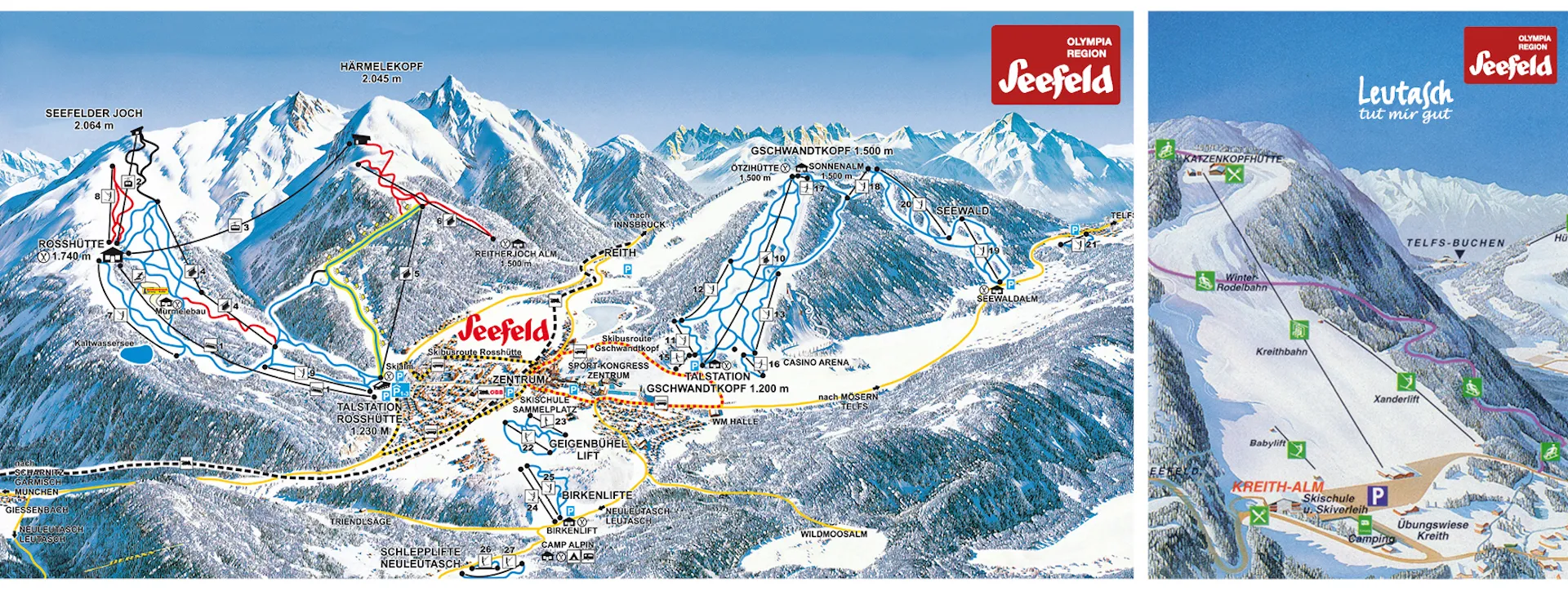
Slope Map
Resort Review
Rosshütte is Seefeld’s main ski area (19.1 km), rising to 2,064 m, with sun-drenched slopes; Gschwandtkopf complements it as a very small, beginner-friendly area of forest runs. Strong for families and Nordic skiing, limited for experts.
Advantages
- Very family- and beginner-friendly (Rosshütte + Gschwandtkopf as clearly defined learning and enjoyment areas)
- A great combination of alpine skiing and a strong Nordic / winter-activities offering in the region
- Clear, easy-to-navigate layout at Rosshütte, with a solid altitude range up to 2,064 m
Disadvantages
- Limited size: for very athletic skiers and long “mile-eater” days, it’s quickly maxed out
- Freeride terrain and snowpark offering are rather small and not designed for experts
- Rosshütte and Gschwandtkopf aren’t directly linked as one continuous ski area (switching between them during the day is usually by bus/transfer)
High-plateau feel: lots of sun, wide-open views — no classic, tight valley skiing
Seefeld doesn’t sit “in a bowl,” but on a high plateau. You can feel that all day long: open terrain, easy orientation, and often an airy, far-reaching panorama — with the sense of truly being up on the mountain, rather than “just” starting out from the valley.
Rosshütte as the core area: compact 19.1 km, but with a real altitude range
The Rosshütte is the main alpine ski area here: 19.1 km of pistes between 1,230 and 2,064 m, plus 12 lifts, offer enough variety for several days — as long as you’re not expecting a vast interlinked mega-area. The piste mix clearly leans blue/red, with very little “black” — ideal for relaxed carving laps and confident intermediates, less so for anyone looking to rack up steep, sporty runs all day.
Infrastructure-wise, there’s a noticeably comfortable set of access lifts; by way of example, the Hochanger 6-seater chairlift is mentioned with weather protection and comfort features. Overall, the area feels fully developed and practical for everyday skiing.
Gschwandtkopf: deliberately small — and therefore stress-free for beginners
The Gschwandtkopf is Rosshütte’s counterpart: a very manageable ski area with around 5–6 km of pistes, almost entirely easy, making it perfect for first turns, lesson groups, and families who like short, repeatable descents. Add to that its character as a wooded, north-facing area, which often makes skiing pleasantly sheltered when the weather is changeable.
Important for planning: Rosshütte and Gschwandtkopf are not linked as a ski circuit; they’re typically combined via ski bus / integrated lift pass.
Freestyle without big-park ambitions: obstacle setups + airbag instead of pro lines
Freestylers will find a small fun/obstacle park at Rosshütte with basic features (including boxes) and a landing pad/airbag. It’s best suited to beginners and casual “on-the-side” practice — if you’re looking for multiple lines, big kicker sets, or a halfpipe, you likely won’t find it here.
Freeride & ski touring: more an add-on than a destination
Seefeld (Rosshütte/Gschwandtkopf) isn’t considered a classic freeride hotspot. Off-piste there are only a few options, and the area communicates ski-touring rules with fixed ascent routes, as well as closures of certain pistes/sections at specific times. Bottom line: interesting for ski tourers; for dedicated freeriding, more of a “nice to have.”
Family logic: large beginner areas + clear meeting points
For families, Rosshütte is very thoughtfully laid out: a large children’s area (named “Sportis Kinderland” with 20,000 m²) plus practice lifts and conveyor belts make getting started easy. Gschwandtkopf rounds out the offering with its very gentle piste profile — handy if you want to stick consistently to “blue” runs for a full day.
Mountain huts & après-ski: close to the base station, straightforward, more laid-back
Après-ski focuses mainly around the Rosshütte base station (including a Schirmbar and the Ski-Alm), alongside classic hut stops up on the mountain. The atmosphere is easy to plan for and low-key — anyone seeking a full-on party cluster like the big hotspots will experience Seefeld as decidedly relaxed.
Beyond skiing, Seefeld is especially strong: cross-country, winter hiking, tobogganing
Seefeld really shines outside alpine skiing: it promotes around 245 km of cross-country trails, plus a broad network of groomed winter hiking paths (142 km) and further classics such as tobogganing. That makes the destination wonderfully well-rounded for mixed groups — even when not everyone wants to ski every day.
Detailed Ratings
With 19.1 km of runs, the Rosshütte offers a complete, highly usable compact ski area (1,230–2,064 m), with an emphasis on blue and red pistes. The Gschwandtkopf, as a very small beginners’ area, is a sensible addition—but it does not replace a large ski resort.
Small fun/obstacle park with easy features and an airbag/landing pad—great for a first taste and for practising, but without extensive park terrain or pro lines.
Freeriding here is more of a side note: there are only a few off-piste options, but clear rules for ski touring, with designated ascent routes and closures. For true powder playgrounds, there are better-suited destinations.
A wonderfully cohesive setup for families: a large children’s area at the Rosshütte (listed at 20,000 m²), additional practice lifts, and—at the Gschwandtkopf—a consistently easy secondary area for relaxed days of learning.
Après-ski is available, especially near the valley stations (umbrella bar/ski lodge), and is geared toward hut stops. Overall, it’s more relaxed than party-driven.
Away from the slopes, Seefeld truly shines: around 245 km of cross-country trails, numerous winter hiking routes (142 km in total), and activities such as sledding make the region ideal for mixed groups.