Piste Overview
Blue
17.2 km (27%)
Red
35.1 km (55%)
Black
11.7 km (18%)
Ski Route
8.2 km
Total: 64 km
Lift System
Gondolas
Chairlifts
T-Bar Lifts
Aerial Trams
Total: 19 lifts
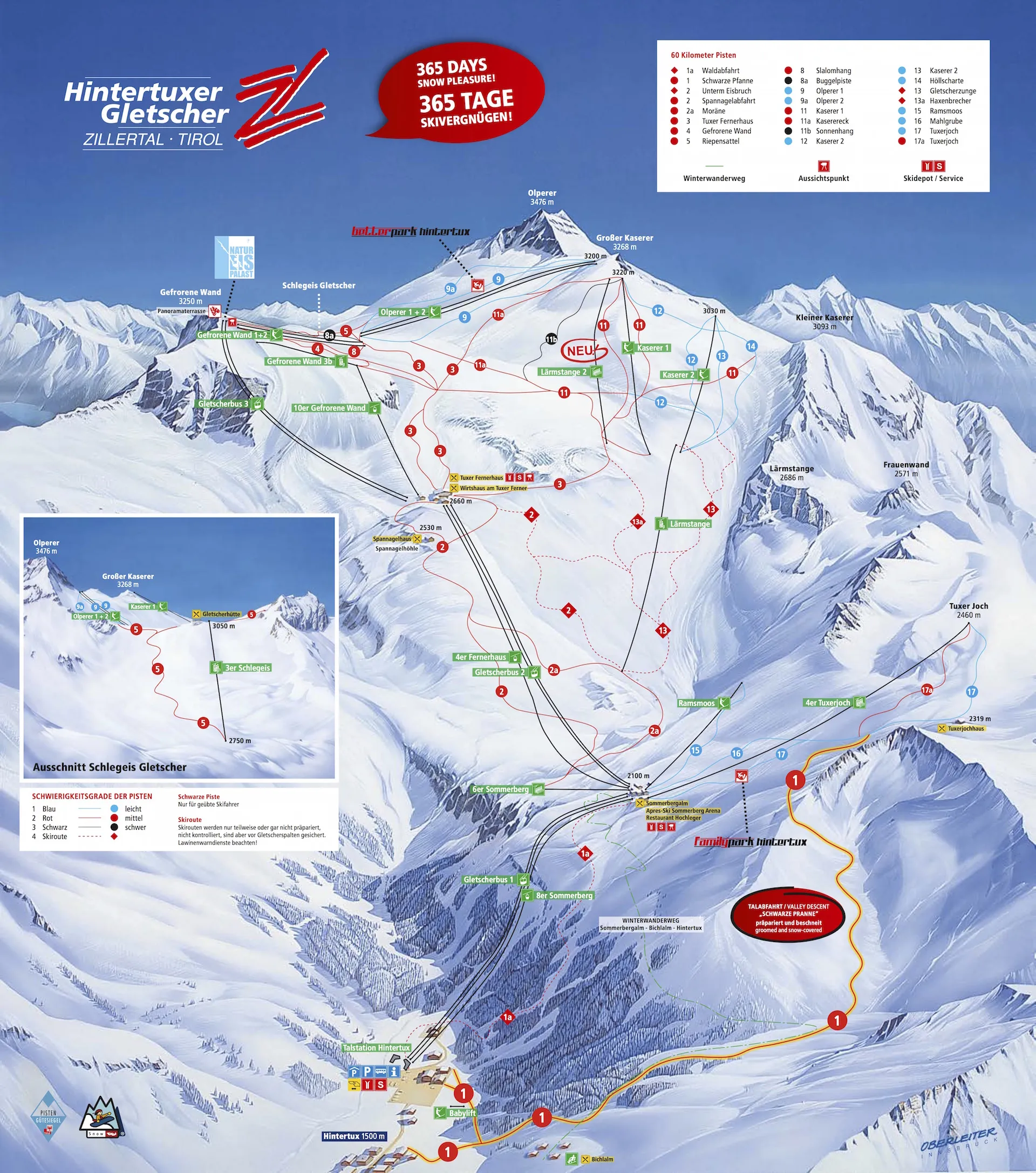
Slope Map
Resort Review
Hintertux Glacier: a high-alpine, year-round ski area (approx. 1,500–3,250 m) with around 60 km of slopes, exceptionally reliable snow, a top-class Betterpark, and unique ice and cave experiences.
Advantages
- Year-round operation and exceptionally reliable snow thanks to the high altitude (up to approx. 3,250 m).
- The Betterpark—an undeniable freestyle magnet, especially in autumn and spring.
- Extraordinary off-slope highlights (Nature Ice Palace, Spannagel Cave, panoramic terrace).
Disadvantages
- Above the tree line: in wind/fog/flat light it can quickly turn unpleasant and require careful navigation.
- For absolute beginners only moderately relaxed (glacier logistics, routes/access to easier runs).
- With around 60 km of pistes, it’s rather “compact” — if you’re skiing day after day, high-mileage riders often wish for more mileage and variety.
365 days high-alpine: Austria’s classic for “safe skiing”
The Hintertux Glacier is the well-known year-round ski area in the Tux Valley: skiing is, in principle, possible here 365 days a year, and the elevation range of around 1,500 to 3,250 m delivers a very high likelihood of snow by Alpine standards.
The flip side of the concept is typical glacier terrain: much of it lies above the treeline—and in wind, fog, or flat light, skiing can quickly feel more demanding than the piste colour would suggest.
A vertical ski area with fast gondolas: lots of vertical, compact piste kilometres
With around 60 km of pistes, Hintertux isn’t a “mega carousel,” but it plays to its strengths through vertical drop and direct uplift: the Glacier Buses take you step by step from Hintertux via Sommerbergalm/Tuxer Fernerhaus all the way to the top.
What’s especially convenient is the focus on comfort and technology: Glacier Bus 3 is considered a spectacular installation and, as a two-rope circulating gondola, a genuine unique feature in the Alps.
Betterpark as the flagship: freestyle shines особенно in the shoulder seasons
Freestyle is a core theme in Hintertux: the Betterpark is regarded as one of the best parks in the Alps and is especially appealing in autumn and spring, with a changing setup of jumps and jibs (rather than as a “daily park” for the entire winter season).
Off-piste variants: possible, but glacier terrain must be taken seriously
Around Hintertux there are freeride options and an established ski-touring scene. At the same time, the rule is: glacier and high-alpine terrain demands avalanche awareness and route-finding competence; for the inexperienced, local accompaniment/guiding is the smarter choice.
Families: good offers – but not the easiest “first ski area”
For children, the Gletscherflohpark and practice areas in the valley/near the Sommerbergalm provide clear anchor points.
For complete beginners, Hintertux is still only conditionally ideal: gentle slopes do exist, but the glacier logic (altitude, weather, and in some cases access only via intermediate sections) can make those first ski days unnecessarily complicated.
Après-ski focused and straightforward: from the mountain down to the base station
The scene isn’t endlessly large, but it’s easy to find: typical meeting points include an umbrella bar in the Sommerberg area and the Hohenhaus Tenne right at the base station.
Beyond skiing: ice worlds, a cave, and views as true bad-weather alternatives
Hintertux scores with unusual programmes away from the pistes: the Nature Ice Palace (an ice cave beneath the glacier) and the Spannagel Cave (a marble cave) are standout excursion destinations, complemented by the panoramic terrace at 3,250 m.
For quieter days, winter hiking and cross-country options in the valley also fit the picture nicely.
Detailed Ratings
Around 60 km of pistes in a highly snow-sure altitude band (approx. 1,500–3,250 m) make Hintertux a dependable choice. Access via the Glacier Buses is quick and comfortable—though it does lack a wooded “bad-weather Plan B.”
The Betterpark is the undisputed highlight for freestylers: perched high up, reliably snow-sure, and featuring a setup that’s regularly refreshed. The offering is typically at its strongest in autumn and spring.
Freeriding and ski touring are well established in the area, but the high-alpine setting comes with glacier-specific hazards. Anyone heading off-piste should take the avalanche bulletin, visibility and their own expertise very seriously—or go with a guide.
Children’s facilities and practice areas are available (including the Gletscherfloh Park). However, for absolute first ski days the area is still not ideal, as many sections are high-alpine and the easy runs do not always offer the simplest logistics.
Après-ski is available and nicely concentrated—from the mountain (Sommerberg) all the way down to the valley station (Hohenhaus Tenne). Expect a focused selection rather than a sprawling nightlife district.
With the Nature Ice Palace, the Spannagel Cave and the panoramic terrace, Hintertux offers remarkably strong alternatives that work even in poor weather. Add to that classic options such as winter hiking and cross-country skiing down in the valley.