Zell am See–Kaprun (Schmittenhöhe & Kitzsteinhorn)
Piste Overview
Blue
60.5 km (43%)
Red
51 km (37%)
Black
28 km (20%)
Ski Route
16.9 km
Total: 140 km
Lift System
Gondolas
Chairlifts
T-Bar Lifts
Aerial Trams
Total: 51 lifts
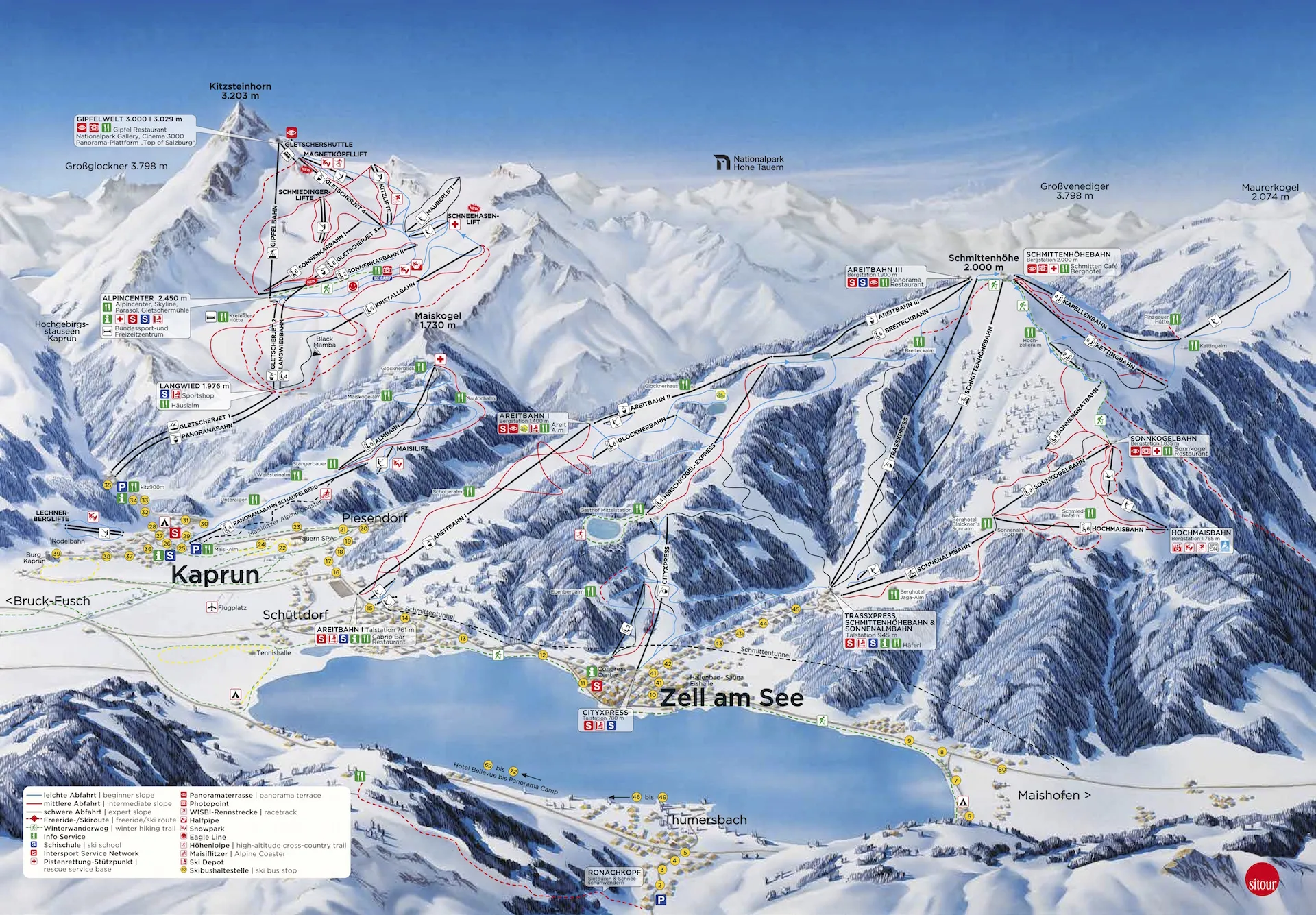
Slope Map
Resort Review
Zell am See–Kaprun combines the panoramic Schmittenhöhe (77 km) with the high-alpine Kitzsteinhorn/Maiskogel (62 km) – strong on altitude, freestyle and families, though transfers are needed between the separate areas.
Advantages
- Two altitude worlds: the high-alpine Kitzsteinhorn (up to 3,029 m) plus the panoramic Schmittenhöhe
- An outstanding freestyle offering on the Kitzsteinhorn (multiple parks + superpipe)
- A family-friendly setup with Maiskogel/Lechnerberg and additional off-snow highlights (e.g., Maisi Flitzer, spa)
Disadvantages
- The sub-areas are not linked as one continuous ski circuit—switching between them requires planning/transfer
- Schmittenhöhe is relatively low in its lower section (valley at ~760 m)—less snow-reliable during warm spells
- For experts, the offering is strong in places (e.g., steep individual descents), but not consistently “challenging only”
Glacier altitude meets lakeside panorama: two sectors with clearly different character
Zell am See–Kaprun works less as “one” linked ski circuit and more as a combination of the Schmittenhöhe (Zell am See) and the Kitzsteinhorn/Maiskogel (Kaprun). That’s exactly what makes it so appealing: up on the Kitzsteinhorn it’s distinctly high-alpine and reliably snowy; on the Schmittenhöhe you get classic piste skiing with panoramic views.
Skiing for several days – but with logistics between the mountains
On the Schmittenhöhe, 77 km of pistes are available up to around 2,000 m; add to that ski routes and a well-balanced mix of easy, intermediate, and more demanding descents.
The Kitzsteinhorn/Maiskogel complements this with 62 km of pistes and an altitude range up to 3,029 m – noticeably more “alpine” and (thanks to its elevation/glacier setting) often the more stable choice when it’s warm or changeable down below.
Important for planning: the main sectors are not connected as one continuous ski circuit – switching between them is more a matter of ski bus/local travel than “just popping across.” Free ski bus connections are a core part of the regional concept.
Freestyle as a true flagship (Kitzsteinhorn) – Schmitten as an entry-level spot
Freestylers will find multiple snowparks plus a superpipe on the Kitzsteinhorn; the setups are designed for different levels (from first-timers to “pro”).
On the Schmittenhöhe there’s also a more compact park (near the funslope), ideal above all as an intro and progression area.
Freeride with structure: marked routes and an info system on the Kitzsteinhorn
The Kitzsteinhorn offers five marked, lift-access freeride routes (with its own information system covering entry points, conduct, and safety checks). For many, this is a low-threshold way into off-piste terrain – but it’s still mountain terrain, so the right gear and know-how are essential.
Families: Maiskogel/Lechnerberg as a safe base, then higher up the mountain
For families, the split is an advantage: the Maiskogel is positioned as the family mountain (gentler slopes, quick access from the village), while the Kitzsteinhorn delivers more space and altitude “up high.” As a non-ski extra, the year-round Alpine Coaster Maisi Flitzer is one of the most obvious alternatives.
Après-ski & leisure: a lively town mix plus a strong bad-weather option
Zell am See has – for a classic holiday town – a noticeable après/bar scene that suits its more compact centre.
Away from the slopes, the TAUERN SPA Kaprun is the most dependable go-to option (sauna world/wellness), alongside regional winter classics such as tobogganing and ice skating.
Detailed Ratings
With Schmittenhöhe (77 km) and Kitzsteinhorn/Maiskogel (62 km), there’s more than enough terrain for several days, with genuine variety across two distinct characters. The Kitzsteinhorn’s biggest trump card is its altitude and glacier skiing; Schmittenhöhe complements it with classic, varied pistes and that satisfying “down-to-the-valley” run feel. The price of this diversity is the transfer logic between the mountains.
The Kitzsteinhorn is clearly one of the region’s freestyle hotspots: several parks with tiered lines plus a superpipe. On the Schmittenhöhe, a smaller park near the funslope complements the offering and works well as an entry point for learning and progression.
With five clearly signposted freeride routes right by the lifts and a comprehensive information and safety concept, the Kitzsteinhorn is, for many, a sensible “next step” beyond the groomed runs. At the same time, it remains true alpine terrain: conditions, visibility, and the avalanche situation ultimately determine the real quality of the experience.
Families benefit from a smart division of terrain: Maiskogel/Lechnerberg for first turns and relaxed skiing, plus broad, easy-to-navigate slopes higher up the mountain. Added highlights are the many alternatives beyond skiing (coaster, spa, ice skating, sledding).
Zell am See feels noticeably more vibrant than many purely alpine villages and offers a solid range of après-ski spots and bars, without the whole area being geared solely around them. Kaprun, by comparison, tends to be a little quieter—ideal for groups with mixed evening plans.
With TAUERN SPA as a bad‑weather ace up your sleeve, plus toboggan runs, ice‑skating options and the Maisi Flitzer alpine coaster, the range of off‑slope activities is unusually strong. Especially for families or non‑skiers, it’s easy to fill an entire day here.